

Scorpion control inspection
We inspect the exterior, entry points, and likely hiding spots to confirm activity. Then we walk you through a plan based on what we find and your layout.
Book scorpion control in Phoenix today for fast help. Our local team inspects, treats, and seals common entry points so you can get back to normal.

“I’ve used Green Home for about 4 years in my old home and moved them with me to my current home. As a 7 year customer, I appreciate GH’s communication, flexibility and most importantly, the professionalism and consideration of their technicians.”
 Mira
We start by identifying scorpion activity and the conditions bringing them in. Next, we treat key areas and entry points, then recommend steps that help prevent a return.
We inspect the exterior, entry points, and likely hiding spots to confirm activity. Then we walk you through a plan based on what we find and your layout.
We apply targeted treatments based on the inspection and your property layout, focusing on cracks, crevices, walls, and shaded zones where scorpions travel and hunt.
We schedule follow-ups to check progress and adjust the plan as needed. If you see renewed activity between visits, ask about our re-treat option for added coverage.
Or call for same-day service

After over a decade of serving Tucson, we understand how to treat the region’s unique pest challenges.

A small, family-owned business, offering friendly, reliable service you can count on.

We treat inside daycares & hospitals – that’s how kid, pet, and eco-friendly our process is.

Our expert pest protection plan ensures pests stay gone—or we come back for free.
Homeowners in Phoenix stick with us because we show up on time and keep scheduling simple. You’ll work with a local AZ team that knows how desert conditions push scorpions toward homes. Our service is kid- and pet-friendly, and if activity pops up between visits, you can request a re-treat. We communicate clearly and leave you with a plan you can follow.
 Rob Wagley
We are very pleased with this pest control service. Our technician, Jay was very informative and sensitive to where he treated. We have dogs, birds and even wildlife that he was careful to protect. We haven’t seen any scorpions, fleas or black widows on our 1 acre + property since Jays campaign. Well done sir. I highly recommend Jay as a green beret bug and pest man.
 Margaret Penning
We just had Chris do our pest treatment, and he did a great job. We are regular users of Green Home Pest, and they’re easy to work with. They schedule the appointment, reschedule is easy if we have conflicts, they let you know who’s coming and when they’re on their way. Great company with great employees.
 Miranda
Green Home has great customer service. Chris came on time, was very friendly and helpful. He did an inspection and completed his work efficiently. I definitely recommend them
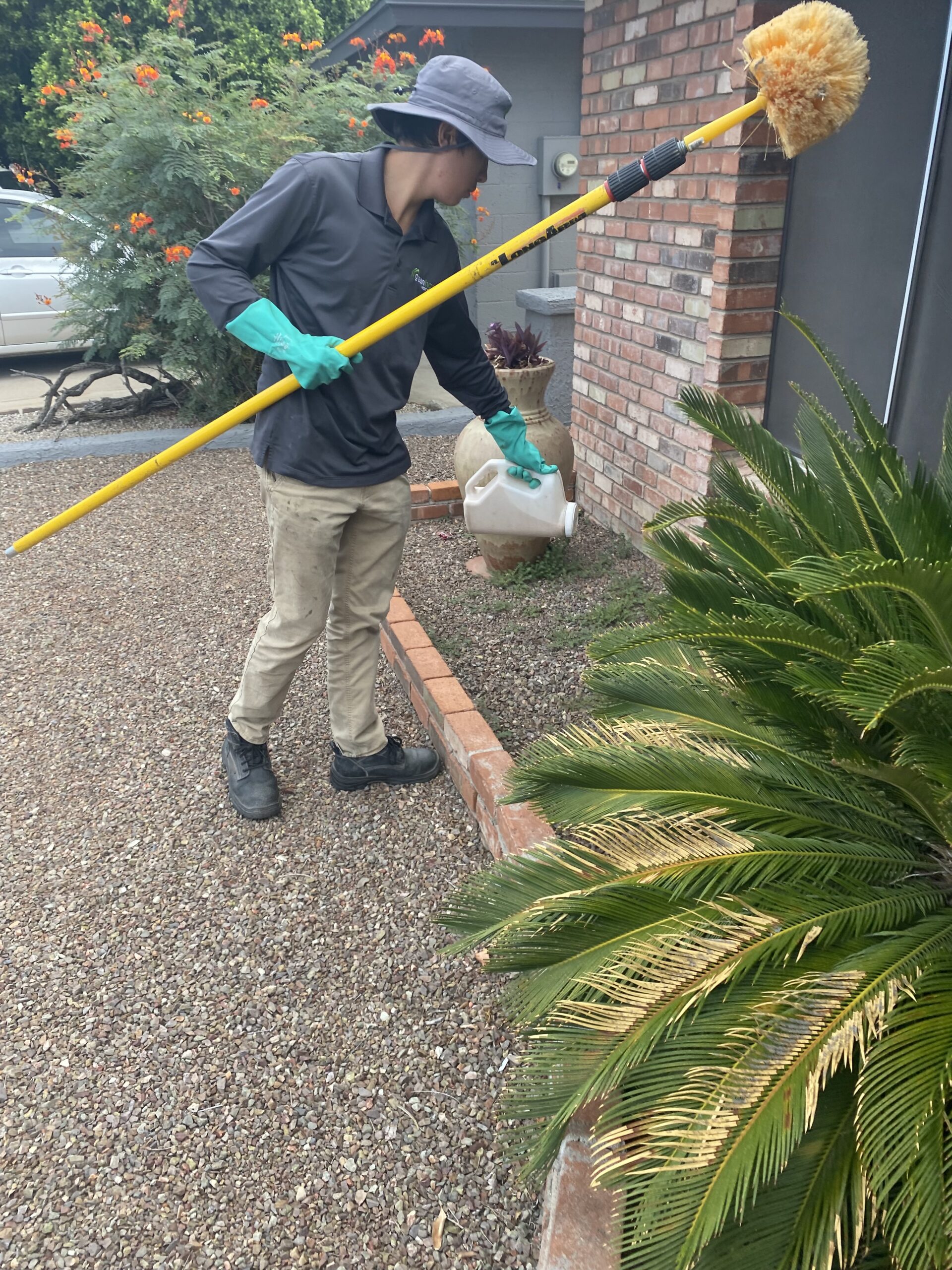
We start with a detailed exterior service because scorpions usually enter through small gaps and travel along walls. Our technician treats the base of the home, expansion joints, and cracks and crevices, then focuses on access points like door thresholds and utility penetrations. We also address the areas that attract scorpions, like clutter, moisture, and insect prey around the structure. You’ll get clear notes on what we did and where scorpions are most likely to show up next.
Scorpions are easiest to spot at night with a blacklight. Although our scorpion control service doesn’t include a blacklight feature, we encourage our customers to use one to help identify where scorpions may be active. Tell us where you’re seeing them, and we’ll use that information to focus treatment on likely hiding spots around your home.
We’ll also recommend simple ways to reduce scorpion activity, such as clearing debris and adjusting outdoor lighting or watering habits. Finding activity hotspots helps us target treatment where it’s needed most.

Scorpion issues often flare during warmer months, so a recurring plan helps keep pressure down as conditions change. We return on a set schedule to treat the exterior, check entry points, and address new conducive conditions that show up over time. We also focus on scorpion food sources by reducing the insects that draw them in. If you spot activity between scheduled visits, we’ll talk through next steps and schedule a re-treat when appropriate.

Scorpions don’t treat Phoenix properties the same, so we tailor service to your layout, entry points, and the conditions around the structure. You’ll get a clear plan, focused treatments, and follow-ups that fit the season and your schedule.

Scorpions in a home usually trace back to wall gaps, garage edges, block walls, and yard clutter that holds insect prey. We inspect the exterior, treat travel zones, and recommend changes that reduce hiding spots. If you’ve had stings or sightings, we can add night checks and sealing work where needed. Ongoing visits help keep pressure down through scorpion season.

Businesses deal with scorpions around loading areas, storage rooms, landscaped entrances, and utility lines that create access points. We inspect the perimeter and high-risk zones, then treat discreetly to limit disruption for staff and customers. Service can be scheduled around operating hours and foot traffic. Follow-ups keep the plan current as weather and site conditions change.

Get total home protection starting at $49 per month. Don’t wait for a problem to happen. Protect your home with our professional and affordable pest control plan for one low monthly price.

4 services per year. 365-day coverage. Our quarterly treatments ensure your home stays pest-free all year long.

No limits. No hidden fees. Need extra help? We’ll return as often as needed—free of charge.

Certified by Arizona’s Department of Agriculture and background-checked for your peace of mind.

A thorough, proven process covering every inch of your home to eliminate pests.

99.9% on-time service with technicians who track every minute spent treating your home.

Avoid $3,000 in repair costs with a free $228 year-round termite protection plan.¹
Or call for same-day service
Phoenix heat and desert conditions can drive scorpions toward shade, water, and wall gaps. We help both homes and businesses with quick scheduling and fast response times, including same-day options when available.
Nearest Location:
16042 N 32nd St Ste B13, Phoenix, AZ 85032
See all service areas we coverThe species homeowners ask about most is the Arizona bark scorpion, which is the one most often linked with indoor sightings because it climbs well and can fit through very small gaps. Other local species can include the stripe-tailed type and the giant desert hairy type. Scorpions may look similar at a quick glance, especially when found in a garage, bathroom, closet, or near block walls, so identification by appearance alone is not always reliable.
Size, color, tail shape, and where it was found can help, but lighting and stress in the moment make mistakes common. If you can safely take a clear photo without handling it, that can help us understand what is active around your home. The next useful step is not just naming the species, but finding how it got close to living areas and what conditions are supporting it.
Indoor sightings are the most obvious sign, but are not the only clue. Activity often shows up near garages, baseboards, bathrooms, laundry rooms, closets, patios, block walls, and door thresholds because these areas offer shade, moisture, insects, or easy access points. You may also notice more crickets, roaches, or other small insects nearby, since those pests can draw in predators. Finding one indoors does not always mean there is a large infestation inside the structure. It may have slipped in from an exterior gap or been carried in with boxes, firewood, patio items, or stored materials.
Repeated sightings, nighttime activity, or finds in multiple rooms are stronger signs that the exterior and entry points need attention. A blacklight check after dark can help reveal hotspots, but a professional inspection is the better way to connect sightings with likely access routes.
Prevention starts with blocking access and reducing the reasons these pests approach the structure. Door sweeps, weatherstripping, garage seals, utility penetrations, weep areas, cracks, expansion joints, and gaps around plumbing or cables are common trouble spots. Outside, remove stacked debris, trim vegetation away from walls, limit heavy ground cover near the foundation, and reduce moisture where possible. Outdoor lighting can also matter because lights attract insects, and insects attract predators. Sealing helps, but it should be paired with exterior service and habitat reduction.
A home can have many tiny openings, and not every gap is obvious during a quick walkaround. That is why professional scorpion sealing is most useful after an inspection connects indoor sightings with likely entry points. If you are handling prevention yourself, begin with doors, garage edges, and utility openings, then look for clutter and water sources along the perimeter.
Professional service combines inspection, targeted exterior work, and entry-point reduction. For scorpion control in Phoenix, AZ, we look at where activity has been seen, how the home is built, where insects are present, and which gaps are most likely to allow movement inside. Treatment commonly focuses on cracks, crevices, wall lines, shaded zones, door thresholds, utility penetrations, and other travel areas. Sealing addresses openings that pests can use to slip into garages, wall voids, and living spaces.
It is important to understand that sealing is not the same as making a structure airtight. Homes shift, materials age, and new gaps can appear over time. Green Home Pest Control also looks at conducive conditions, such as moisture, clutter, and insect prey, because entry-point work is stronger when the surrounding presence is reduced. The goal is a practical barrier strategy, not a simple spray-only approach.
Frequency depends on the property, past activity, landscaping, construction style, and how often new openings appear. Sealing is usually not something to redo on a fixed calendar without checking conditions first. Door sweeps wear down, garage seals flatten, caulk can separate, and utility areas may change after repairs or weather exposure. Treatments are often more effective as part of an ongoing prevention approach because pest issues change through the year.
Our Green Home protection program includes recurring service, and our technicians can recommend a cadence based on what is found around the structure. Some homes need more attention during warmer activity periods, while others mainly need a strong exterior service and gap correction. If you have repeated indoor sightings or new construction changes around the property, it is worth scheduling an inspection rather than guessing. That gives us a clearer basis for timing and next steps.
Call when sightings become repeated, when one is found inside a living area, or when you are seeing activity around doors, garages, patios, bathrooms, or bedrooms. A single outdoor sighting near a wall may be handled with prevention steps, but indoor activity means there may be access points worth addressing. It is also smart to call after a sting, after finding them during blacklight checks, or when you notice an increase in insects that may serve as food. Waiting can allow the same entry routes and hiding spots to keep causing problems.
A professional visit can separate occasional outdoor activity from a pattern that needs treatment and sealing. We can inspect the perimeter, focus service on likely travel zones, and explain which changes matter most. If you are unsure whether the issue is isolated or growing, schedule service and tell us exactly where and when sightings are happening.
Many homeowners notice reduced activity after service, but the timing can vary. These pests hide in tight spaces, move mostly at night, and may continue crossing treated areas after the visit. Exterior conditions, weather, insect activity, clutter, moisture, and unsealed gaps all affect how quickly sightings slow down. A treatment is not a magic switch, especially if the property has heavy block walls, dense landscaping, garage gaps, or ongoing prey insects nearby.
You may still see occasional activity as hidden pests move through or as new ones approach from outside. What matters is whether sightings decrease and whether the activity remains concentrated around known access points. Keep notes on locations, dates, and times, and use a blacklight if you are comfortable checking safely from a distance. If activity continues between scheduled visits, our pest-free guarantee and re-treat options may apply based on your service plan.
During the visit, we ask where sightings have occurred, then examine the exterior, likely hiding places, entry points, and conditions that may support activity. The service may include focused application to cracks, crevices, foundation edges, expansion joints, shaded areas, thresholds, and utility openings. We also point out practical changes, such as reducing debris, adjusting moisture, improving door seals, or clearing insect-friendly clutter.
Afterward, you should watch for patterns rather than judging the result by one isolated sighting. Note whether activity is indoors or outside, whether it appears near the same gap, and whether insect prey is still present. Follow-up service may be scheduled to check progress and adjust the approach when needed. Green Home Pest Control uses kid and pet-friendly products and clear communication, so you know what was addressed and what you can do next to help keep pest presence down.
"*" indicates required fields